




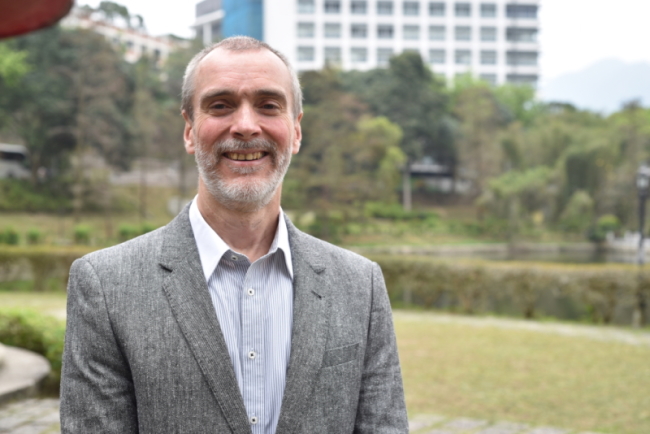
Welcome to the website of the Department of Translation at The Chinese University of Hong Kong!
Our department has been at the forefront of translation education and translation studies research in Hong Kong for over 50 years, and I am glad to say that reports of the demise of translation have been greatly exaggerated!
The introduction of new technologies and the (at times exhausting) influx of AI tools has undoubtedly changed the face of our field. Yet, translation has always been at the vanguard of technological change. For more than half a century, computers have assisted us in translating; the process has simply grown more automated over time.
Around a decade ago, the narrative in our field was often about striving to be "better than Google Translate". The point now is not to compete with or simply be "better than" AI, but to be able to identify what might be missing from an automated message and what could be worded with greater cultural resonance. Ours is a discipline with no single "right" answer, making translation at once treacherous and liberating. While the barrier to entry for basic translation has become extremely low, top-level translation work is in higher demand than ever. Someone must make critical decisions about which wording to use in specific contexts, whether in written translation or spoken interpretation. Today’s language professional is no longer a mere conduit for words, but a linguistic arbiter and a cultural adjudicator.
As a department, we are constantly evolving. We have introduced new courses to help our students navigate these new realities, teaching skills that go far beyond simply transferring text between two languages. At CUHK, we are pioneering a curriculum built on a powerful fusion of deep linguistic mastery and cutting-edge technical proficiency. While you might look to other disciplines to learn the raw mechanics of how to engineer an AI model, here you will learn how to train these systems with linguistic and cultural nuance. Our students use computers to manage large-scale projects, analyze data, and identify cultural bias. They learn to rigorously interrogate AI outputs, critically evaluate the natural language generated, and refine translations until they meet the highest standards of communication.
As an avenue of academic enquiry, translation studies at CUHK goes well beyond interlingual transfer, expanding into intermodal, intersemiotic, and intercultural spheres. We position ourselves at the forefront of research that combines traditional humanities scholarship with technological innovation. At the same time, we share a commitment to linguistic justice. In an era where AI models are overwhelmingly trained on a few dominant tongues, we advocate for a unified, ethical stance against algorithmic homogenization.
I invite you to explore our website to discover more about our community, and look forward to welcoming you to our department.
Warm regards,

Duncan James Poupard
